
Why marine protected areas need more than a boundary line
A marine protected area is only as good as what actually happens in the water inside it. Take Nusa Penida: the waters around Nusa Penida, Nusa Lembongan and Nusa Ceningan have been managed as a marine protected area for over a decade, covering just over 20,000 hectares and home to close to 300 coral species and more than 500 reef fish species — recognized as a Mission Blue Hope Spot in 2020. That protection status doesn’t, by itself, stop a dive boat, a fishing boat or a liveaboard from dropping anchor straight onto living coral. It just means someone is supposed to be doing something about it.
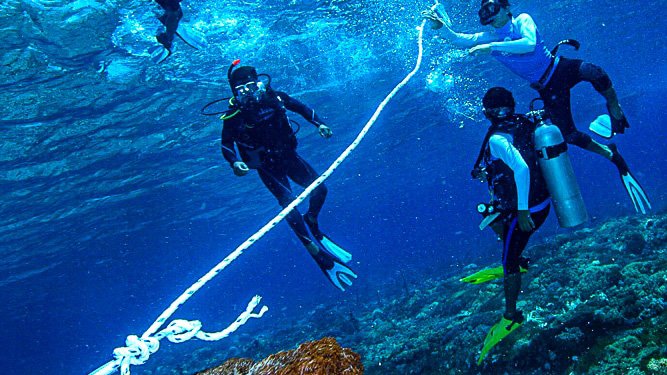
That “something” is usually a mooring system — and it’s one of the simplest, cheapest, most effective conservation tools available, when it’s done properly. When it isn’t, it can end up causing the exact damage it was meant to prevent. We’ve seen that firsthand: an unpermitted mooring dragging concrete blocks across the reef in Ped, and, separately, one of our own moorings shifting into water shallow enough to damage the reef — both ended up causing more damage than no mooring at all would have.
This guide is the detail behind that story: what actually makes a mooring reef-safe, and where they tend to go wrong.
Why anchoring is one of the biggest threats a healthy reef faces
An anchor and chain dropped onto a reef doesn’t just crush whatever coral it lands on. As the boat swings with wind, current and surge, the chain drags back and forth across the seabed, scarring a much wider area than the anchor’s actual footprint. Those scars — bare rock and rubble where a reef used to be — can take years, sometimes decades, to recover, according to marine mooring specialists Hazelett Marine. The dragging also stirs up sediment, clouding the water and smothering coral downstream, and the same physical damage applies to seagrass beds, another critical nursery habitat.
The frustrating part is that a lot of this damage is entirely preventable — not by keeping boats out of the water, but by giving them somewhere fixed and safe to tie up instead.
How a mooring helps, when it’s done right
The basic idea behind an environmentally friendly mooring is simple: instead of every boat dropping and dragging its own anchor, one fixed point is installed once, correctly, and every boat afterward just clips onto a line hanging from it. Done properly, nothing drags, nothing new touches the reef, and the same mooring point can serve dozens of boats a day for years without additional damage. Diver-safety organization DAN and reef-tourism groups like Green Fins both treat permanent mooring systems as the default alternative to anchoring wherever boats regularly need to stop over reef.
The catch is in that word “properly.” A mooring is a piece of infrastructure sitting permanently on a reef, and like any infrastructure, a bad one is worse than none — which is exactly what the wrong anchor, the wrong size, or a badly rigged rope can turn it into.
Choosing the right anchor for the seabed
There’s no single correct anchor type — the right choice depends on what’s actually on the bottom:
- On hard substrate (reef rock or limestone): an embedment or “pin and eye” anchor is drilled directly into the rock, then set with hydraulic cement rated to cure underwater. A stainless-steel rod with a welded eyehole sits flush with the substrate, and the mooring line shackles onto that single point — as described by DAN for reef mooring programs.
- On soft substrate (sand or rubble): a driven embedment anchor — often called a manta ray anchor — is the standard option. A long rod with a pivoting, spade-shaped head is driven into the sand, then set so the head pivots horizontal underground, locking it in place with very high holding power for its size. Helical (screw-in) anchors are another widely used option on soft seabeds, turned into the substrate like a giant screw rather than driven in.
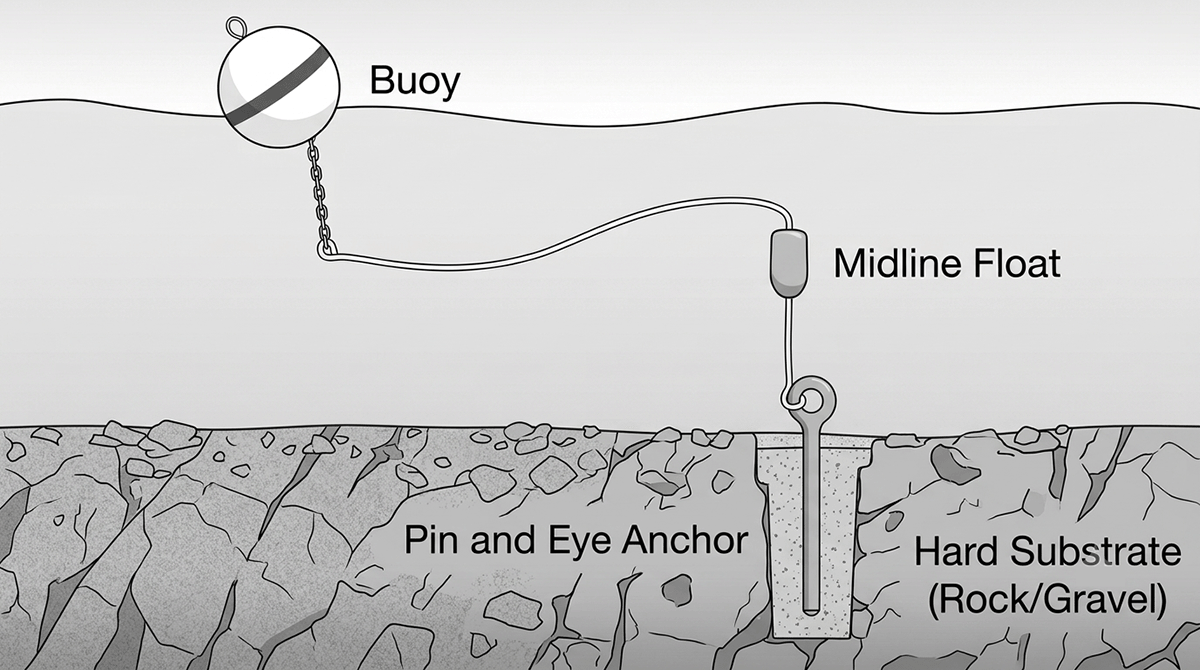
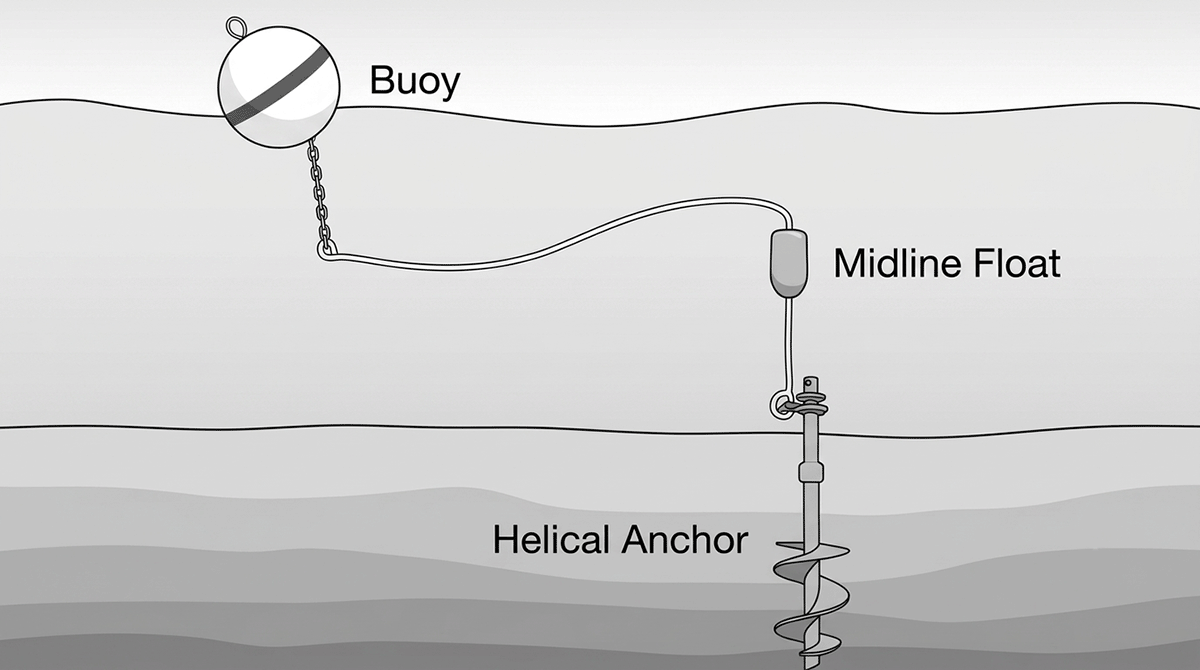
Whichever type is used, three principles matter more than the hardware itself:
- Site it in a reef-free area — sand or rubble patches clear of live coral, not anywhere the anchor point or the swinging boat above it can make contact with the reef.
- Size it for the boat. A mooring rated for a small dinghy will fail — or drag — under a liveaboard. Ocean Gardener’s own moorings use a visibly different buoy size for small boats versus larger vessels, precisely so a boat can’t end up on a mooring that isn’t rated to hold it.
- Set it so boats float clear of the reef at every tide, not just at high water — a boat that swings into contact with the reef at low tide defeats the entire purpose of the mooring.
Getting the rope right — this is where most moorings actually fail
An anchor point that’s perfectly sited can still wreck a reef if the rope above it is rigged badly. A few details make the difference between a line that stays clear of the coral and one that saws through it:
- Run the mooring line at an angle, roughly 35–40° from the seabed to the surface float, rather than straight up. This keeps tension on the line so it doesn’t go slack and drop onto the reef, as outlined by Conservation Diver’s mooring-line guidance.
- Keep the connecting swivel and loop underwater, below the surface, even when the mooring isn’t in use — not floating loose where it can whip around and abrade against rock or coral.
- Protect every friction point. Where the line passes through a loop or swivel, that point should be reinforced with thick vinyl tubing or an equivalent chafe guard, since this is where ropes wear through first.
- Keep the pick-up line separate from the main mooring line. The line a boat actually grabs and clips onto should be a distinct piece of rope from the line running down to the anchor — marked with its own small float — so the boat’s movement doesn’t transmit directly down to (and abrade) the anchor line itself.
None of this is exotic engineering. It’s mostly about accepting that rope is a wear item, not a permanent fixture, and rigging it in a way that fails safely rather than by dragging across coral.
Maintenance: the part almost everyone forgets
A mooring installed correctly on day one doesn’t stay correct forever. Rope degrades in seawater and UV — that’s not a defect, it’s just what rope does. The problem is what happens next if nobody’s checking: the rope eventually gives out, and all that’s left is a bare concrete block or anchor point, no longer suspended off the seabed, but sitting loose and getting dragged around by every boat, current and surge that passes through — scraping and killing coral with each movement.
This isn’t hypothetical for us, either. More than once, one of our own moorings in Ped has shifted out of position over time — we caught it and moved it back to the correct spot, and after it happened again, we removed that mooring for good rather than keep resetting it. A mooring system needs a maintenance schedule as much as it needs a good initial design: regular checks on the rope condition, the chafe points, and whether the anchor is still sited correctly, before a worn line turns a conservation tool back into a source of damage.
What this means for marine park managers, dive operators and communities
Coral takes years to grow back once it’s broken — an old-growth forest supports far more life than a replanted one still catching up decades later, and a reef works the same way. That’s what makes a well-sited, well-rigged, well-maintained mooring one of the highest-value things a marine protected area, a dive operator, or a coastal community can invest in: it protects reef that already exists, at a fraction of the cost and time restoration takes.
If you’re a dive shop, hotel, community group, or MPA authority in Indonesia planning to install moorings — or trying to work out why an existing one isn’t holding up — this is exactly the kind of assessment we help with in Ped, Nusa Penida. Get in touch with Ocean Gardener and we’re glad to share what we’ve learned the hard way. And if you’re a mooring provider who’d like to sponsor a mooring in Bali, or for one of our course alumni working in their own community elsewhere, please don’t hesitate to reach out.