
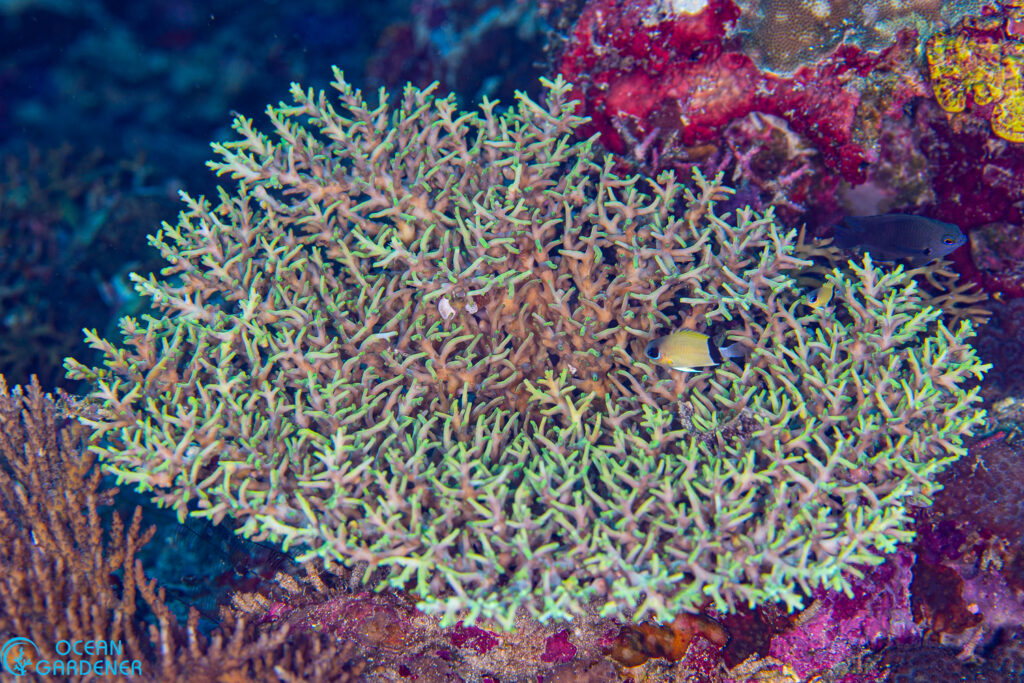
There are a few corals named after Indonesian individuals; Acropora delsawii is among them. We will probably come back to the others, like Acropora sukarnoi, A. batunai, or A. suharsonoi, later on. This unique coral, with its sharp and fragile appearance, is truly iconic of the Spice Islands.
Named after an iconic defender of the Banda islands magnificient beauty:
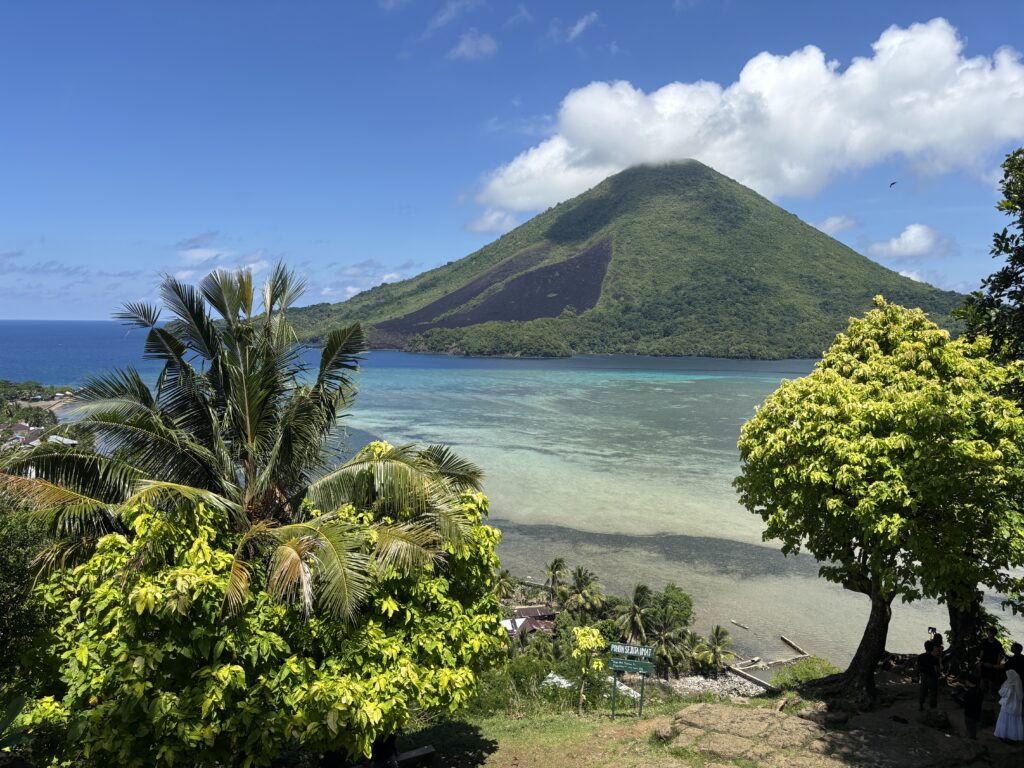
Des Alwi Abubakar, was an Indonesian historian, diplomat, writer, and advocate from the Banda Islands. A true conservationist, who was trying to preserve the beauty of the Banda Islands, known for the origin of the Nutmeg, and develop quality tourism in this unique place.
Recently described:
Acropora desalwii was only described in 1994 by Carden Wallace, with specimens originally from the Banda Islands.
Colony Shape:
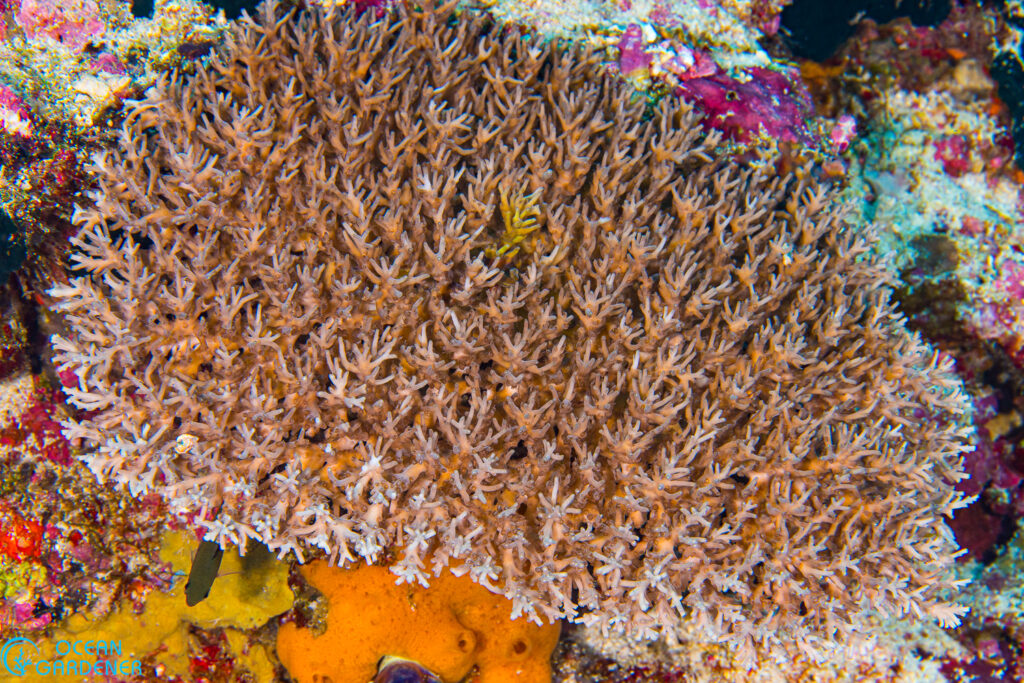
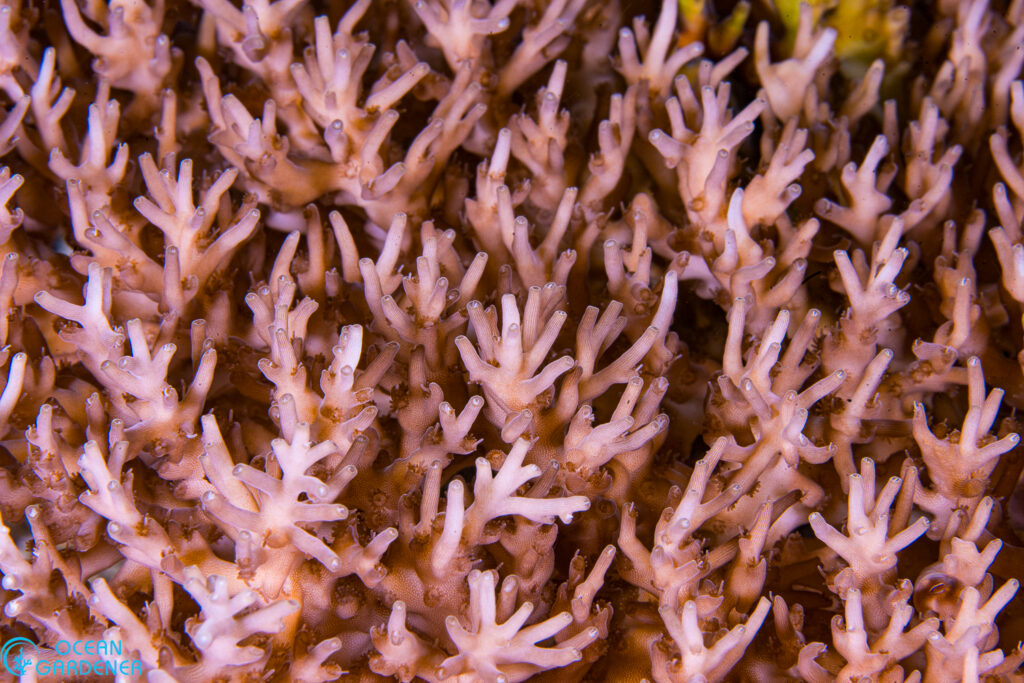
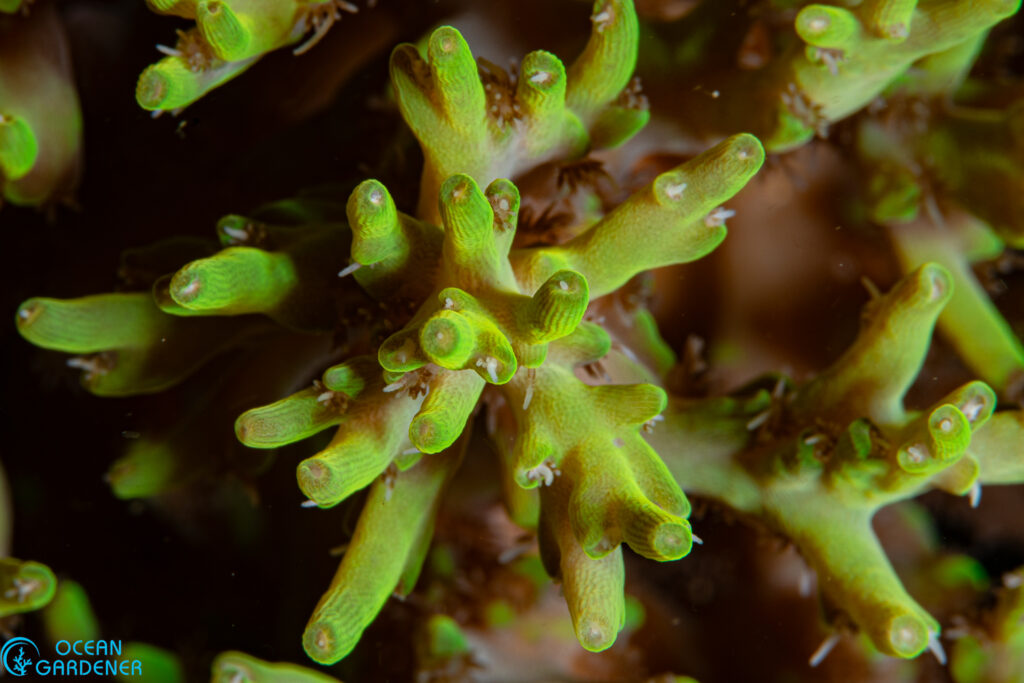
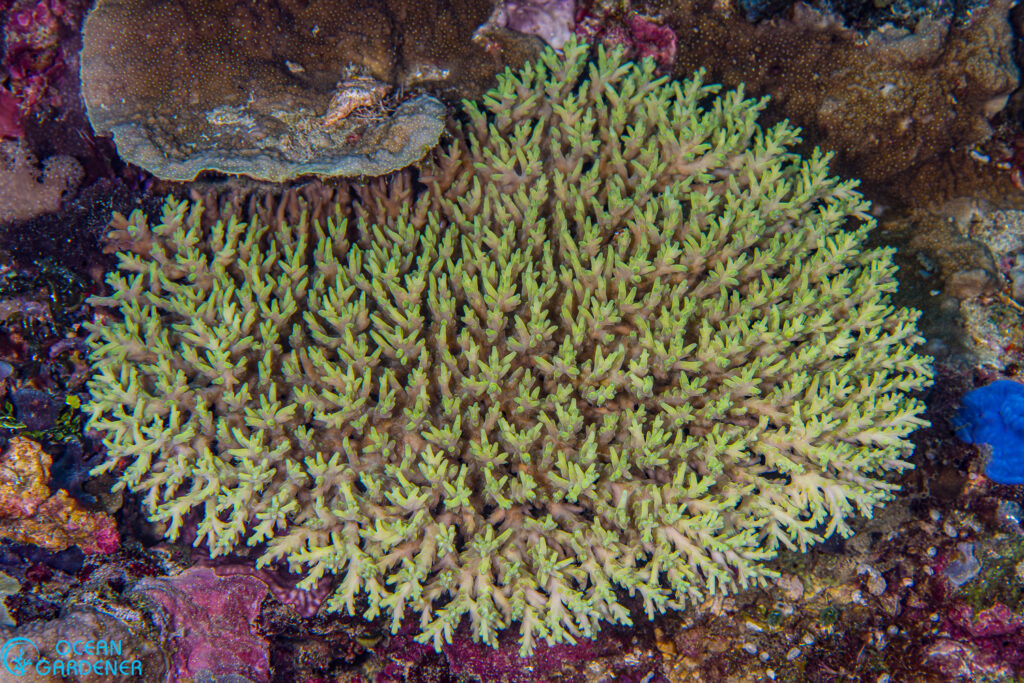
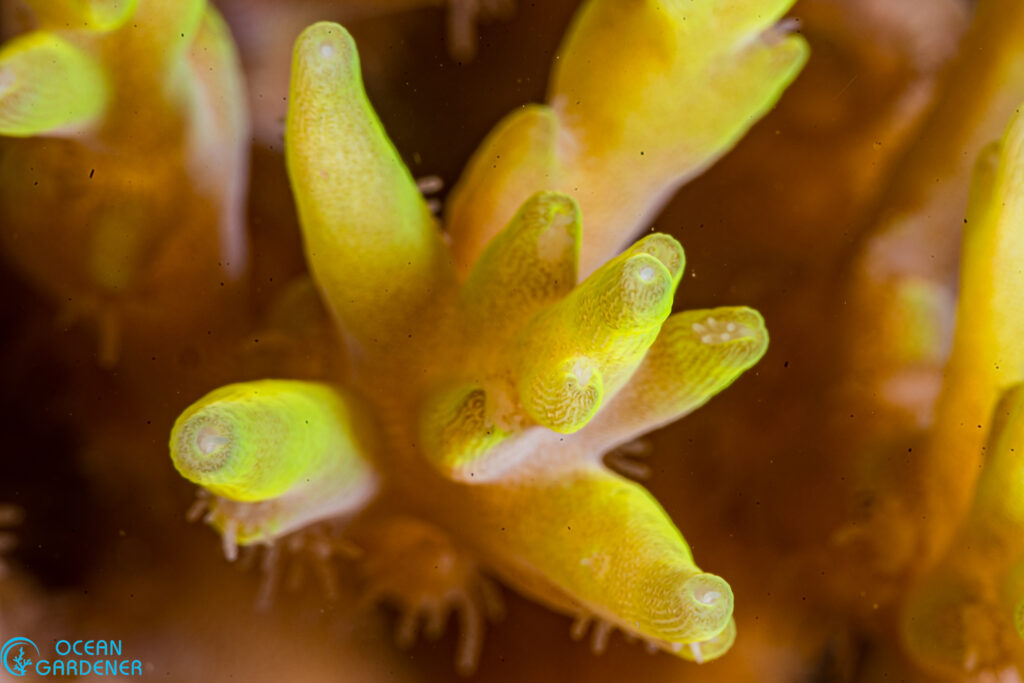
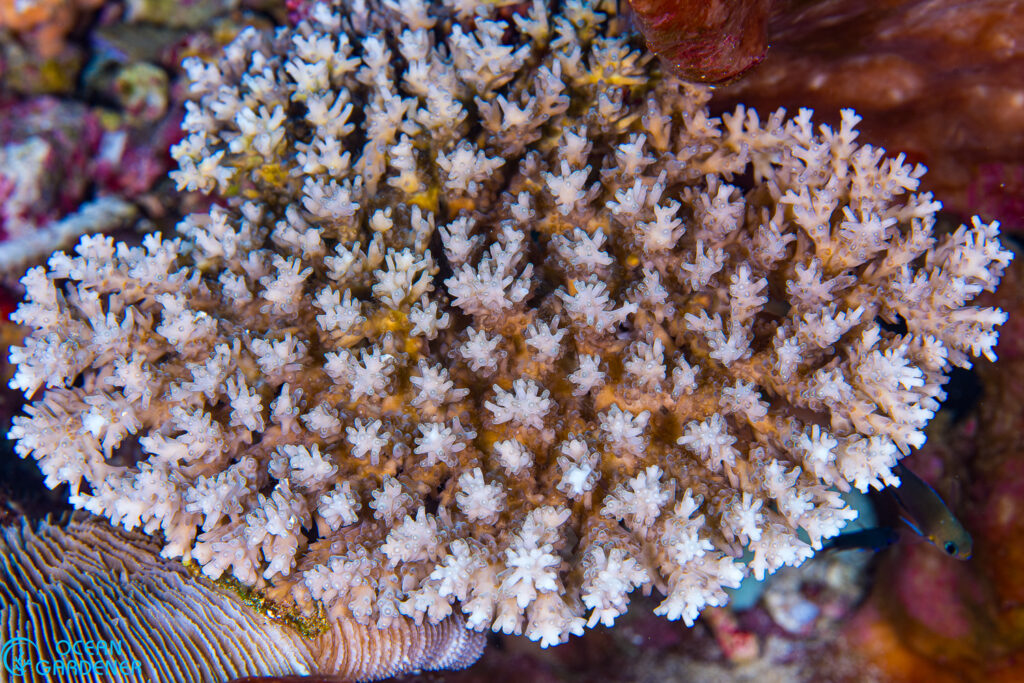
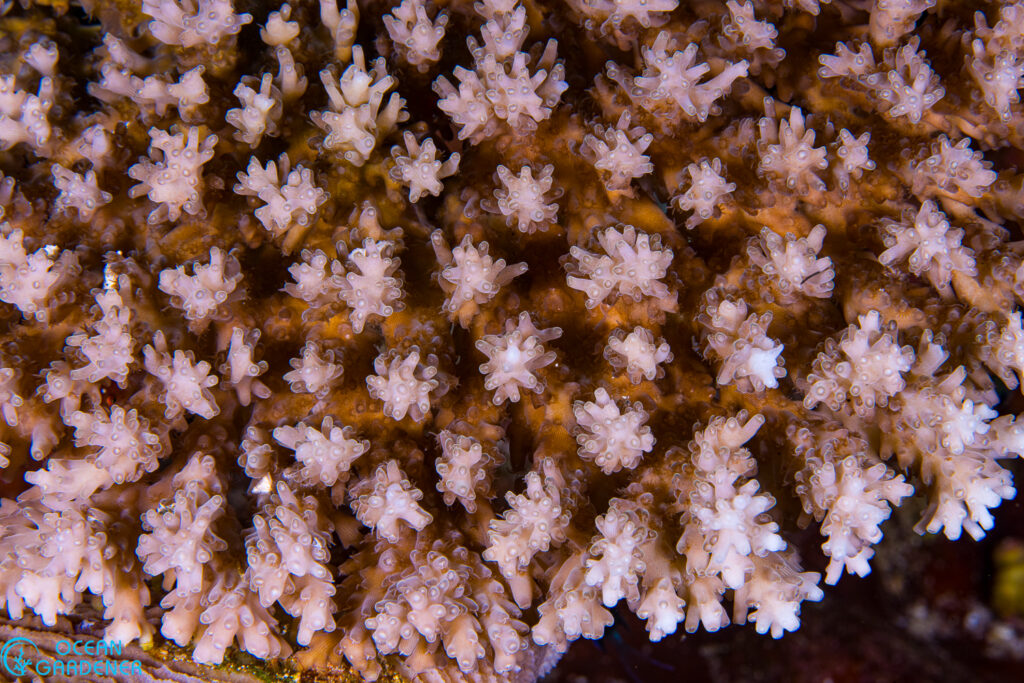
Colonies are corymbose plates with crowded corallites, giving them the appearance of a spiny pillow. The characteristic multidirectional, multiple axial corallite ends on proximal vertical branchlets are very unique in the Acropora world. It doesn’t possess tertiary branches. Branches are thin: 2,5 – 4,9 mm only.
Colonies do not exceed 60 cm in diameter.
Corallite:
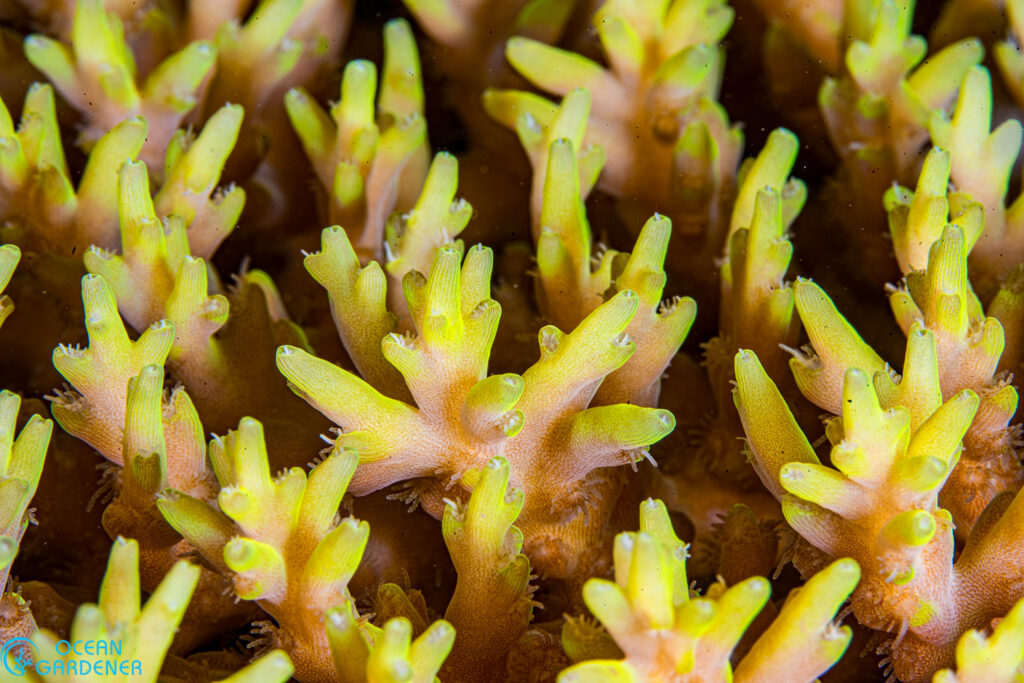
- Axial corallites are long, tubular, upright, and quite thin: only 1 to 1,2 mm in diameter.
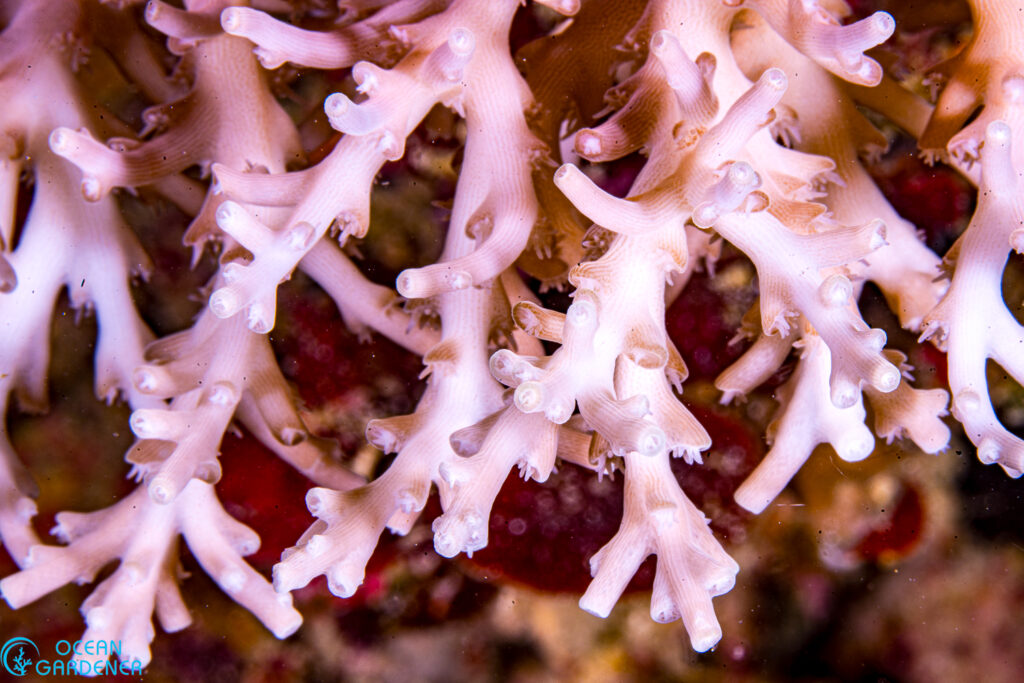
- Radial corallites are dimidiate with elongated lips on central branchlets and mainly appressed tubular with oval-rounded openings on distal branches. Their density is low, giving the colony a really spinny, but smooth skin appearance.
Color:
Most colonies are brown with a slight red-pink hue. Light blue or yellow specimens are also common, and some staggering colonies can get bright fluorescent green.
Habitat:
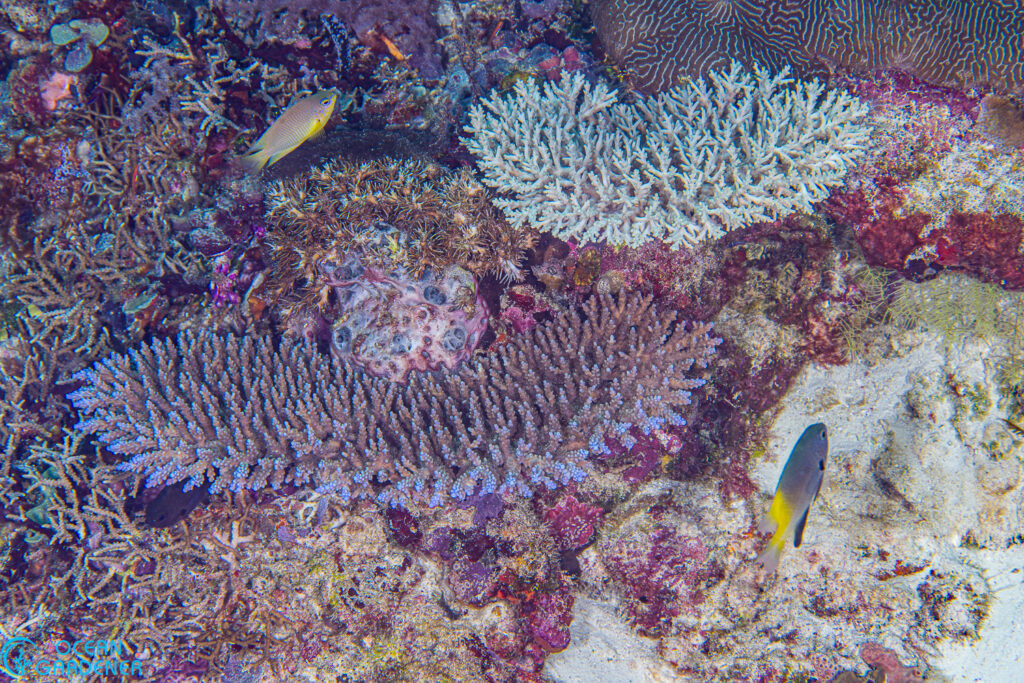
Protected Drop-off or Steep slope, from 10 -30 m deep.
Distribution:
It is found in the broad Coral Triangle, with the highest abundance being in the Area overlapping the North of Indonesia and the South of the Philippines.
Similar species:
Acropora willisae also has long tubular axial corallites, but these are all vertical. Acropora caroliniana has much thicker axial corallites and more cylindrical. Acropora jacquelinae has much thinner axial corallites.
Placticity:
In places with slightly higher flow, Acropora desalwii can change overall shape quite substantially, becoming more compact.
The Architects of the Reef: Understanding Genus Acropora
As the primary builders of Indo-Pacific reefs, corals in the genus Acropora—including staghorn and tabular varieties—are ecologically indispensable. Known as “foundation species,” their rapid growth and intricate skeletal structures create the complex 3D architecture that sustains marine biodiversity. By prioritizing these species in restoration work, we can accelerate habitat recovery and invite marine life back to the reef faster than with any other group.
Acropora delsawii is a prime example of the specialized diversity found within this group. If you want to master the identification of these essential reef-builders and observe them in their natural environment, we invite you to join our Acropora ID Course in Bali. Enhancing your species knowledge is the best way to improve restoration success rates and contribute meaningfully to Indonesia’s marine conservation efforts.