
What photogrammetry actually is, and why we use it
Photogrammetry is the science of extracting 3D information from ordinary 2D photos. In practice, that means one of our divers swims a fixed pattern over a restoration site with a camera, taking hundreds — sometimes thousands — of overlapping photos, with small corner markers and scale bars placed on the reef beforehand so every survey lines up with the last one.
Specialized software then stitches all of those overlapping images together into a single high-resolution 3D model or overhead map (or orthomosaic image) of the site: a photomosaic you can measure, rotate, and compare directly against the same site surveyed months or years earlier.
That last part is what makes it so useful for restoration work. A single photo tells you what a reef looked like for a moment, from one angle. A photogrammetry model tells you how it’s actually changing: not just whether coral cover is increasing, but how the structural complexity — the rugosity — of the reef is developing as coral colonies grow, branch, and fill in the space around them. That structural complexity matters as much as raw coral cover, since it’s what creates the nooks, shelters and surface area that fish and invertebrates actually depend on.
It’s also simply more efficient than most of the alternatives. Traditional survey methods like line transects are accurate but slow and limited to a narrow strip of reef at a time. A single photogrammetry survey can cover an entire restoration site in one dive, and because the resulting model is a permanent digital record, we can go back and re-measure or re-analyze it later without ever getting back in the water.
Photogrammetry is one of the core techniques we teach in Module 4 of our full coral restoration certification course, alongside Rapid Reef Assessment and quadrat transects — if you want to actually learn to run a survey like the ones below, that’s where to start.
Here’s what two years of that kind of monitoring actually looks like, at two of our restoration sites.
Photogrammetry work on the Shallow Table Acropora nursery, before and after
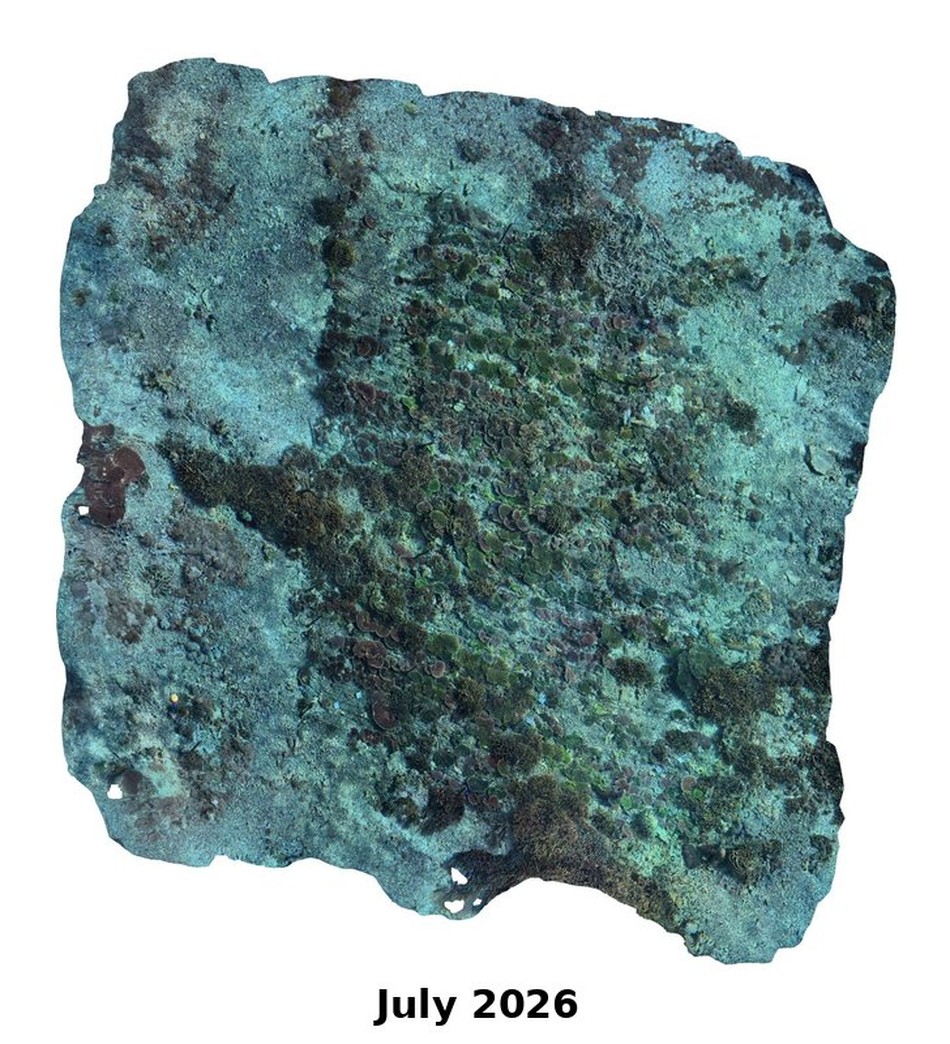
We’ve been monitoring one of our nurseries with photogrammetry to track coral cover and benthic composition over time, at a site where we planted Acropora tables — including Acropora spicifera, Acropora bifaria tenuis, Acropora millepora and Acropora anthocercis.
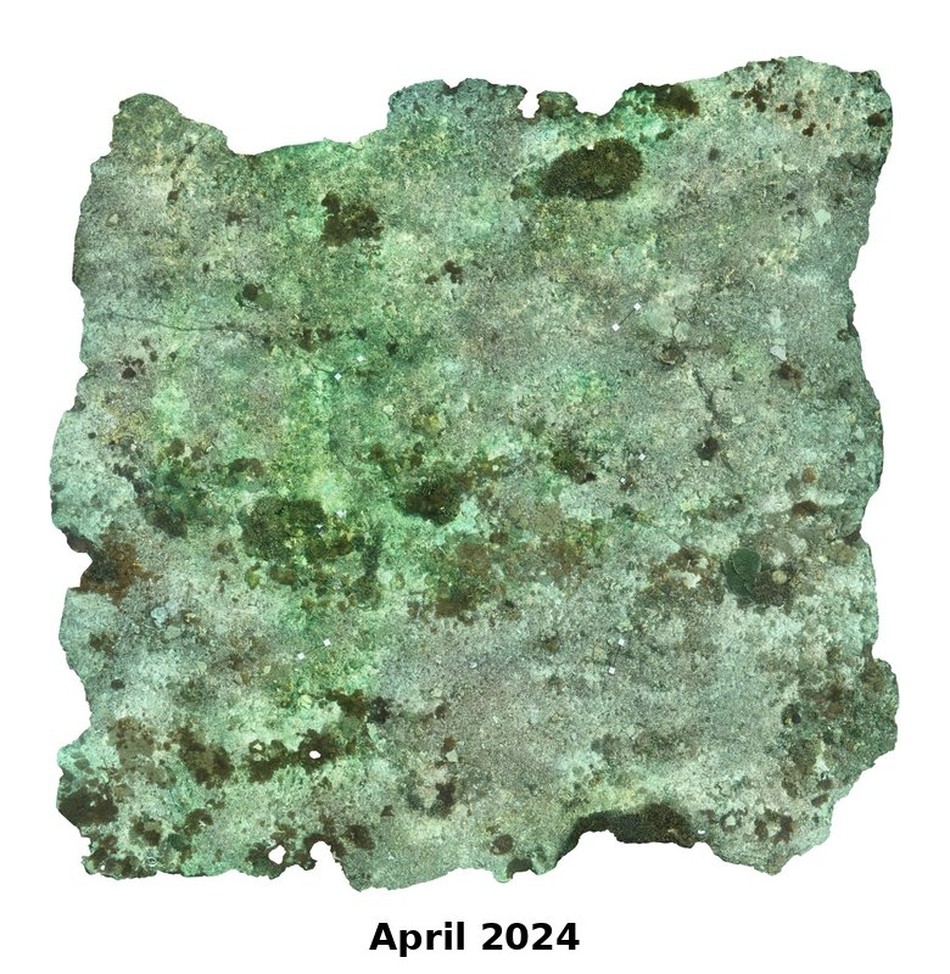
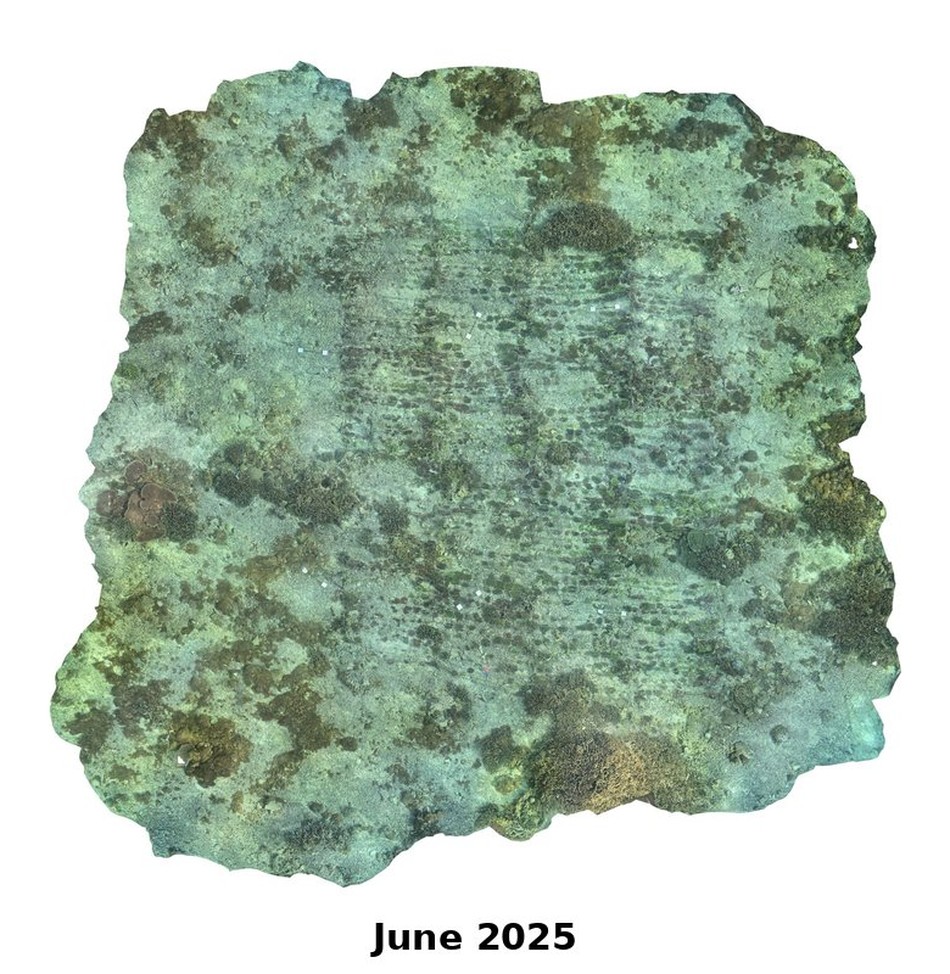
Before we built the nursery, back in April 2024, the site was mostly bare rubble and invasive soft coral (Xenia), with only a few small patches of healthy coral. Fourteen months later, the Acropora tables were showing good signs of growth and had made it through the stressed period that follows outplanting — visibly growing over the rope and the open wounds left by fragmentation, and starting to put their energy into expanding as colonies rather than just surviving.
The most recent survey, from July 2026 — 13 months after that — shows a genuinely satisfying result: most of the rope is now covered by coral growth, and the corals have survived their thermal stressors. That’s not a small thing at this particular site. The nursery sits in shallow water that runs hot, and during spring tides the corals are briefly exposed above the surface entirely. The fact that they’ve survived and adapted through that means we’re likely looking at a nursery of thermally resilient corals — exactly the kind of stock worth propagating further as ocean temperatures keep climbing.
Photogrammetry work on Seatrees 1, before and after
Seatrees 1 is one of our coral outplanting sites, and it has a feature none of our other sites share: it’s where we re-introduced 150 juvenile Tridacna maxima back into the reef ecosystem, becoming the first project to combine giant clam reintroduction with coral restoration back in November 2025.
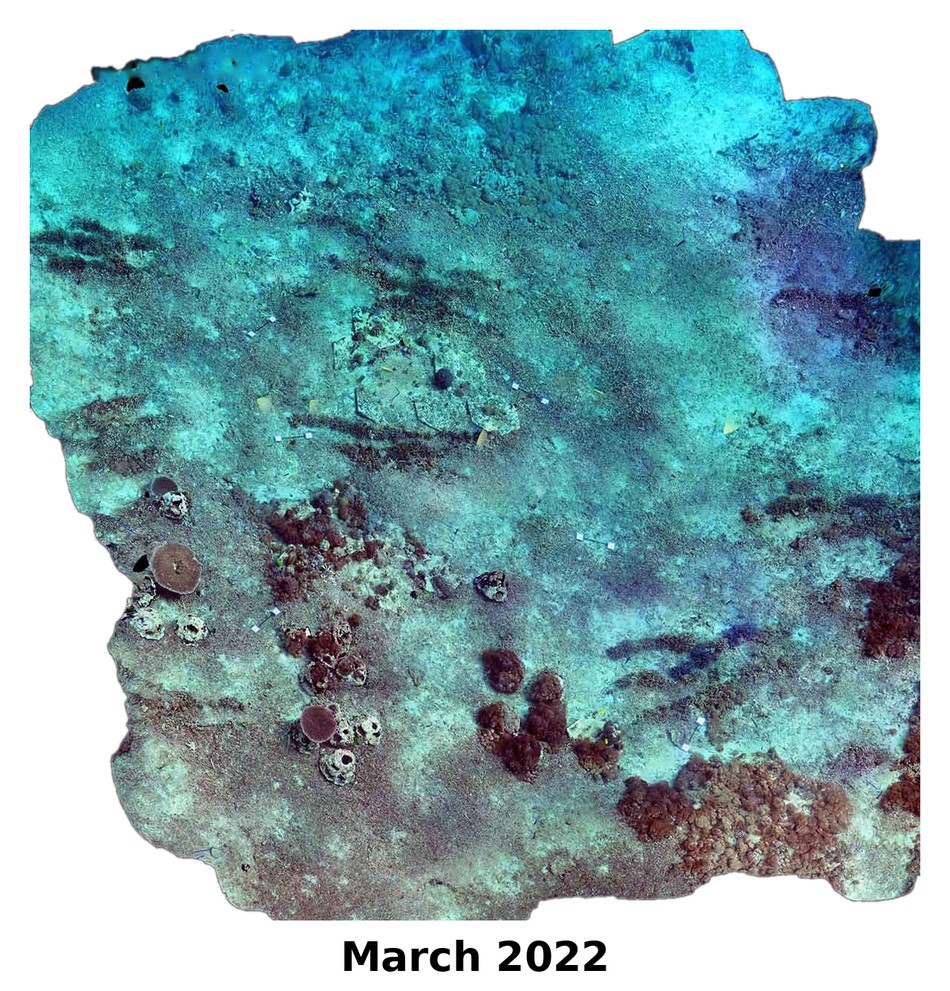
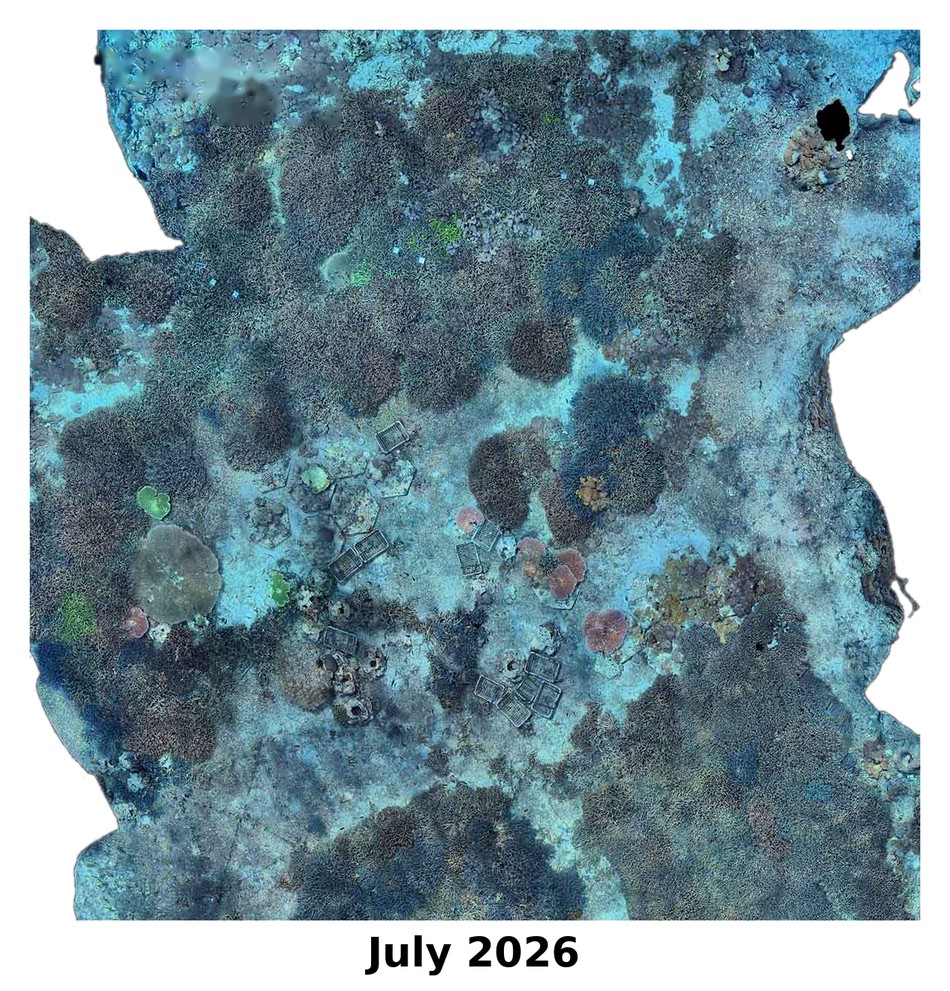
The photogrammetry results here show rapid growth of the outplanted corals around the clam baskets over time — some of the concrete hexagonal structures we used are already fully overgrown by branching Acropora colonies. The corals were planted alongside the clam baskets using the rope-and-stake outplanting method, the same technique that’s proven highly effective at our main restoration site in Ped, Nusa Penida. Beyond the branching Acropora, plating and table-form Acropora colonies are filling in throughout the area too, adding to the site’s structural complexity as it matures.
Photogrammetry hasn’t only shown us growth here — it’s also let us track the less encouraging side of monitoring. In some colonies, we can see coral disease progress and spread across successive surveys, in a few cases resulting in the loss of an entire colony. That’s exactly the value of this kind of long-term monitoring: it doesn’t just document success, it gives us an early, measurable warning when something is going wrong, so we can decide whether a site needs intervention rather than finding out only once the damage is done.
An ongoing record, not a one-off snapshot
Photogrammetry isn’t just how we show off progress — it’s how we actually calculate coral cover, track shifts in biodiversity, and catch problems early enough to act on them. We’re continuing to map both of these sites, along with the rest of our restoration areas in Ped, on a regular survey schedule, and we’ll keep this page updated as new results come in.
If you are interested in learning how to do photogrammetry, take Week 4 – Reef Monitoring Techniques of our Coral Restoration Full Certificate.