
Why we’re comparing restoration methods instead of picking one
Coral reefs worldwide are declining fast — climate change, bleaching events, plastic pollution, untreated wastewater, and a long list of other human-driven pressures are all compounding. In response, restoration projects have multiplied, and so have the techniques: reef restoration today spans everything from steel frames to woven rope to poured concrete, each with its own advocates and its own trade-offs.
Here’s the problem: there’s no universally “right” or “wrong” restoration method. The best choice depends on the environmental conditions and characteristics of the specific site — a technique that thrives on a sandy, high-current site can fail completely on a rocky, low-current one. That makes choosing both the right site and the right method one of the most consequential decisions in any restoration project, and it’s a decision that’s usually made on instinct and prior experience rather than side-by-side evidence.
So we’re generating that evidence ourselves.
Four methods, one reef, a direct comparison
We’re running a controlled study comparing four widely used coral restoration methods at our Nusa Penida site:
- Reef Stars — modular steel structures coated in sand, widely used in large-scale restoration programs across Indonesia.
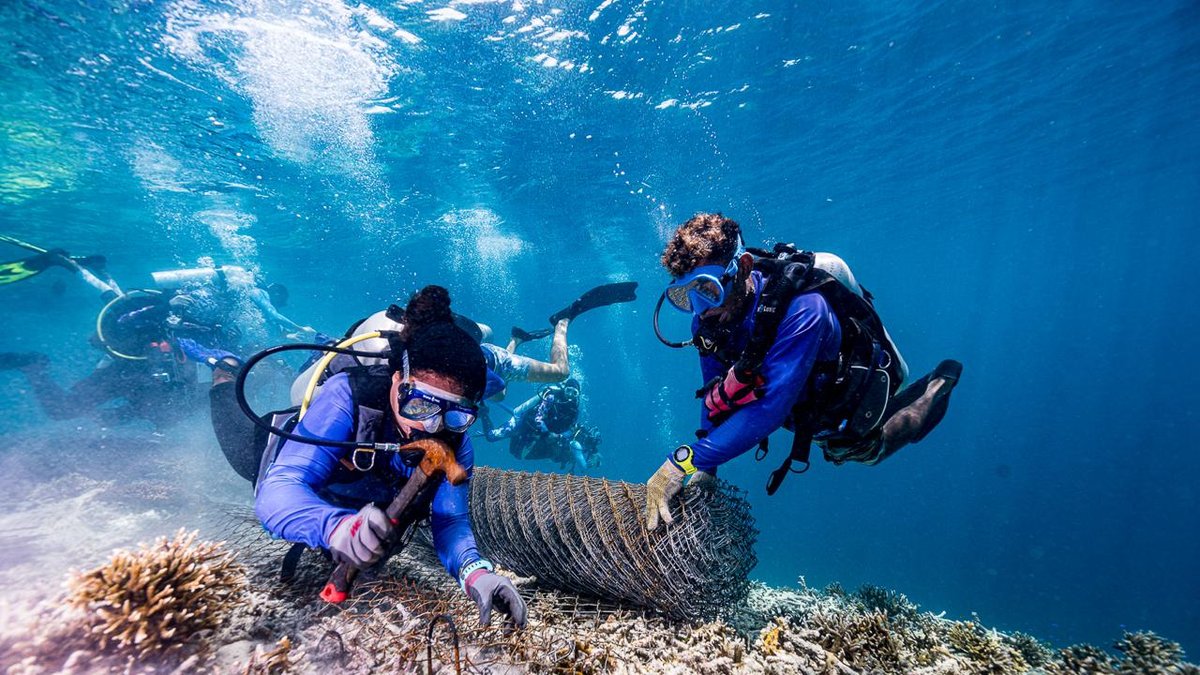
- Wire Mesh Stabilization — coral fragments secured to a wire mesh laid over the substrate.
- Concrete Structures — coral fragments attached to poured concrete forms.
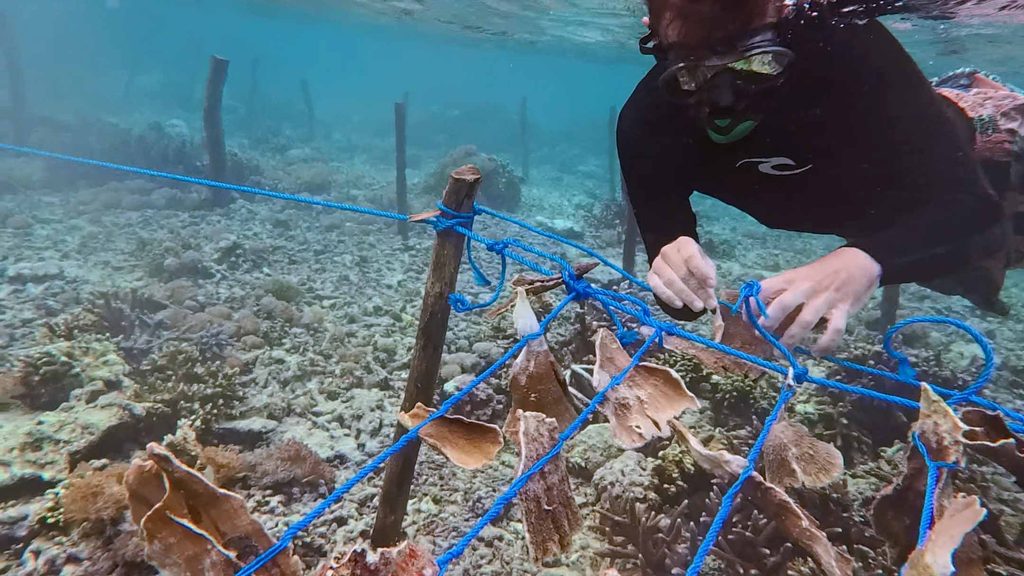
- Rope-and-Stake Method — a traditional technique developed and adapted from local communities here in Nusa Penida, and the technique we rely on most at our own restoration site in Ped.
You can see read about the methods of coral restoration in more detail. They are also covered in Week 3 – Reef Restoration Techniques in our Full Certification course.
Rather than judging these on ecological results alone, we’re evaluating each from three angles: ecological performance, social impact, and financial feasibility — because a method that produces great coral growth but is too expensive or too labor-intensive for a local community to maintain isn’t actually a viable restoration solution in the field.
How the study is designed
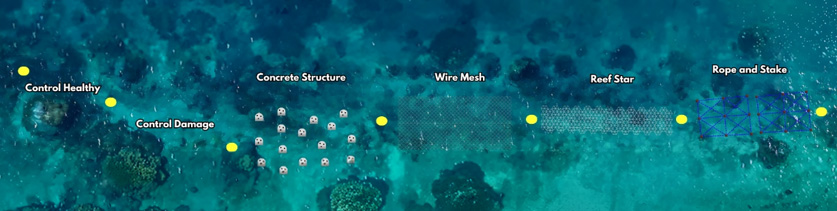
The setup is a 150-meter permanent transect, divided into six monitoring areas: the four restoration methods above, plus two control sites — one healthy natural reef and one degraded reef with no restoration intervention. Running true controls alongside each method is what makes the comparison meaningful: without them, there’s no baseline to say whether a method is actually outperforming what the reef would do (or fail to do) on its own.
Ecological performance is tracked two ways:
- 10×10m photogrammetry surveys to monitor coral cover and benthic composition over time — the same 3D-mapping technique we use to track growth at our other restoration sites.
- Underwater Visual Census (UVC) surveys to monitor reef fish communities across each zone, since a restoration method’s value isn’t just about coral cover — it’s about whether it actually rebuilds a functioning reef ecosystem that fish and other marine life return to.
Monitoring runs every six months, starting with a baseline survey before coral outplanting even begins, so every method is measured against the same untouched starting point rather than compared after the fact.
Financial feasibility is being tracked just as rigorously — comparing the real costs behind each method: initial construction and installation, coral planting material, how often each structure needs maintenance, how long each maintenance session takes, how many people it takes to run one, and the long-term maintenance cost over the life of the site. A method that looks cheap to install but needs constant, labor-heavy upkeep can end up the most expensive option once you account for the years after installation — which is exactly the kind of thing this study is designed to surface.
Social impact is the third pillar of the assessment, alongside ecology and cost — looking at how each method fits with community involvement and local capacity. That piece of the study is still being written up, and we’ll share it once it’s ready.
What we’re hoping to learn
This isn’t a one-off comparison — it’s a long-term monitoring program, and the value will build as the surveys accumulate over multiple years rather than from any single check-in. What we’re ultimately after is a practical, evidence-based answer to a question every restoration project eventually has to face: given a specific site’s conditions, which method actually delivers the best combination of coral survival, ecosystem recovery, cost, and long-term maintainability?
We’ll be sharing results as the monitoring progresses — for now, the baseline surveys are underway, and the four methods are in the water side by side for the first time.