
Some of us are just obsessed with Acropora, with some Acropora species so unique that they hold a very special place in my heart. Recently, on a deep dive in North Bali. I got extremely lucky to find a few specimens of Acropora Jacquelinae, the ‘Bird Nest’ Acropora. These corals, at this size, are becoming really difficult to find here in Bali.
It was first described in 1994 by Carden Wallace, an Australian scientist and a renowned expert on corals, particularly the genus Acropora (staghorn corals). A cool anecdote: We asked Dr. Paul Muir (another renowned Coral Reef Ecologist) where the name came from, he told us that it was named after Jackie Wolstenholme, who was Carden Wallace’s assistant. The convention at that time was to use girls’ first names and guys’ last names. So in fact, many coral species were named after girlfriends!
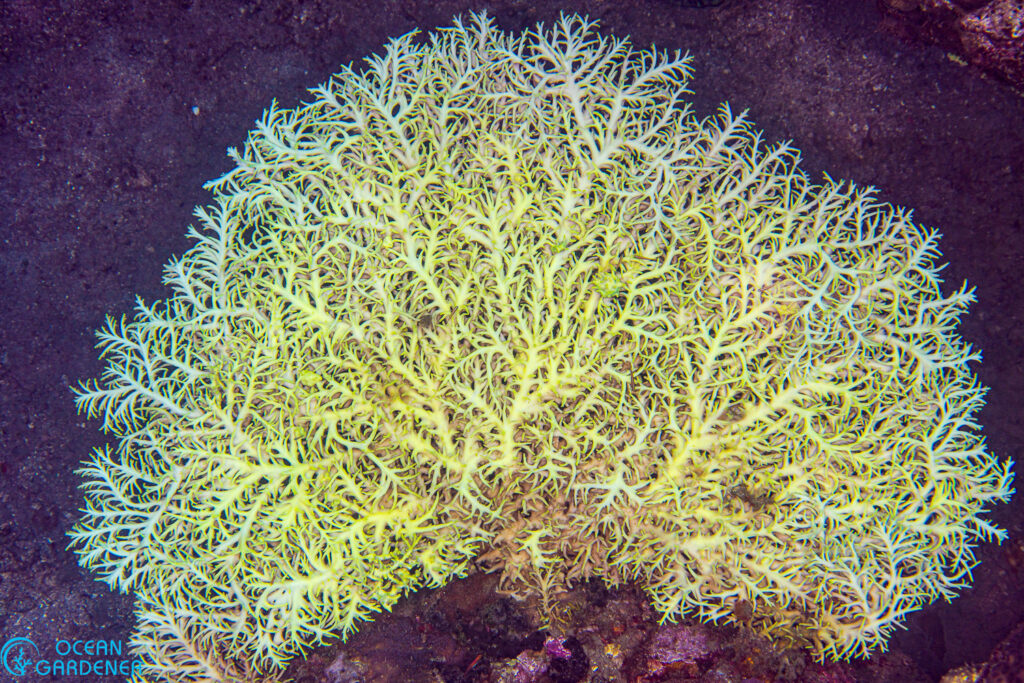
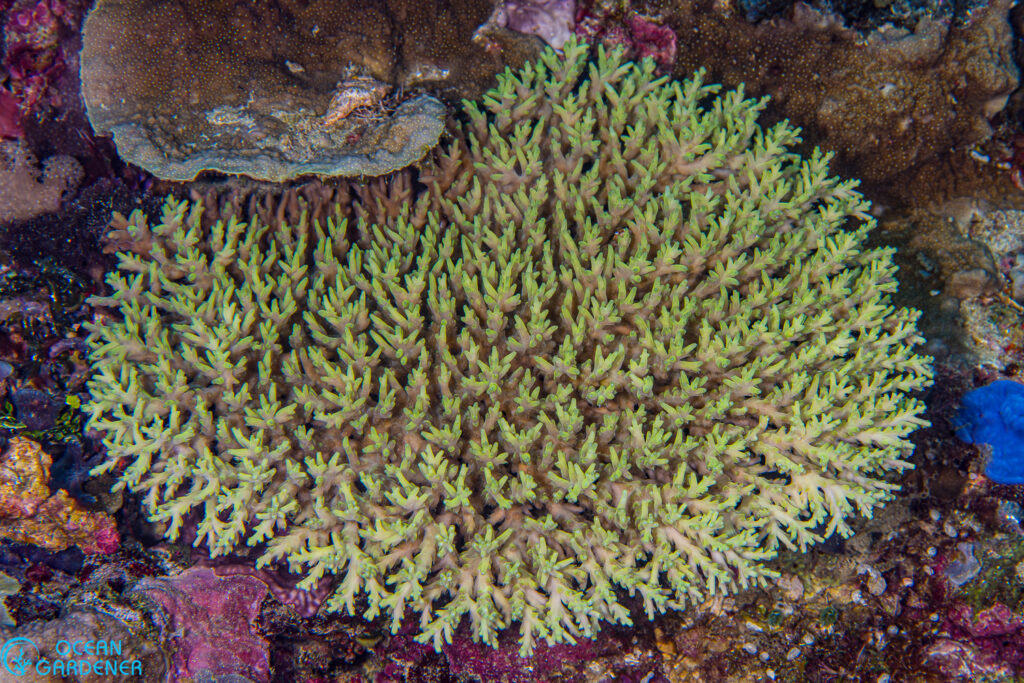
A. Jacquelinae’s very characteristic colony shape
Acropora jacquelinae produces large, thin, table Acropora colonies. Branches are extremely fine, horizontal, and delicate.
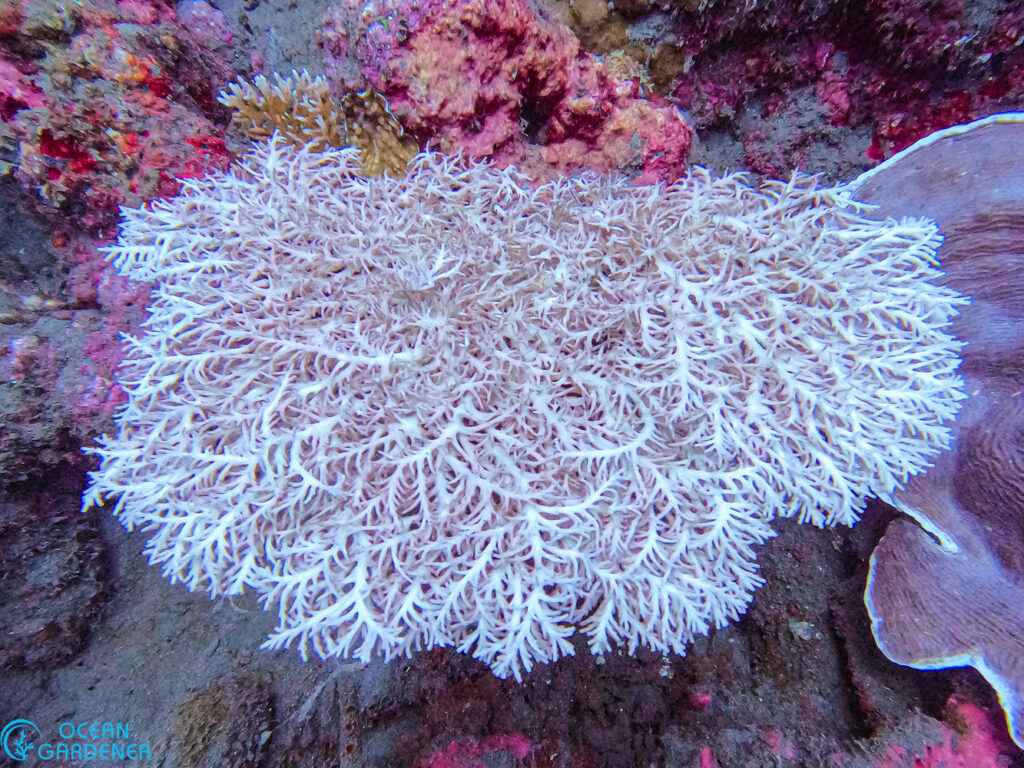
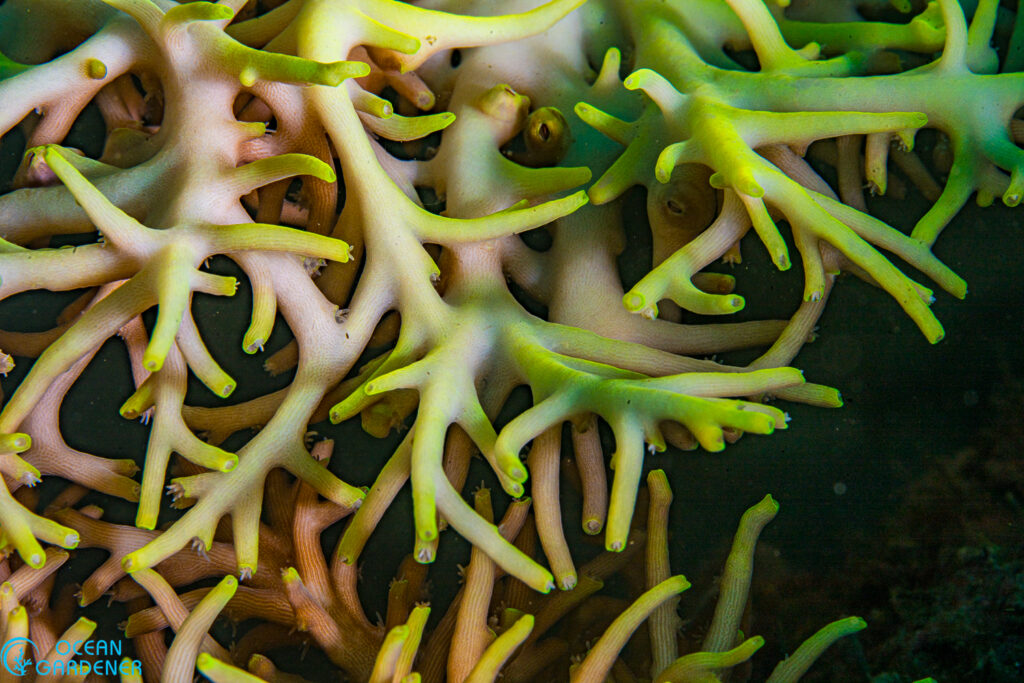
It’s an Axial corallite-dominated Acropora. Radials are almost absent. The main characteristic is to have curved axial corallites and branch tips.
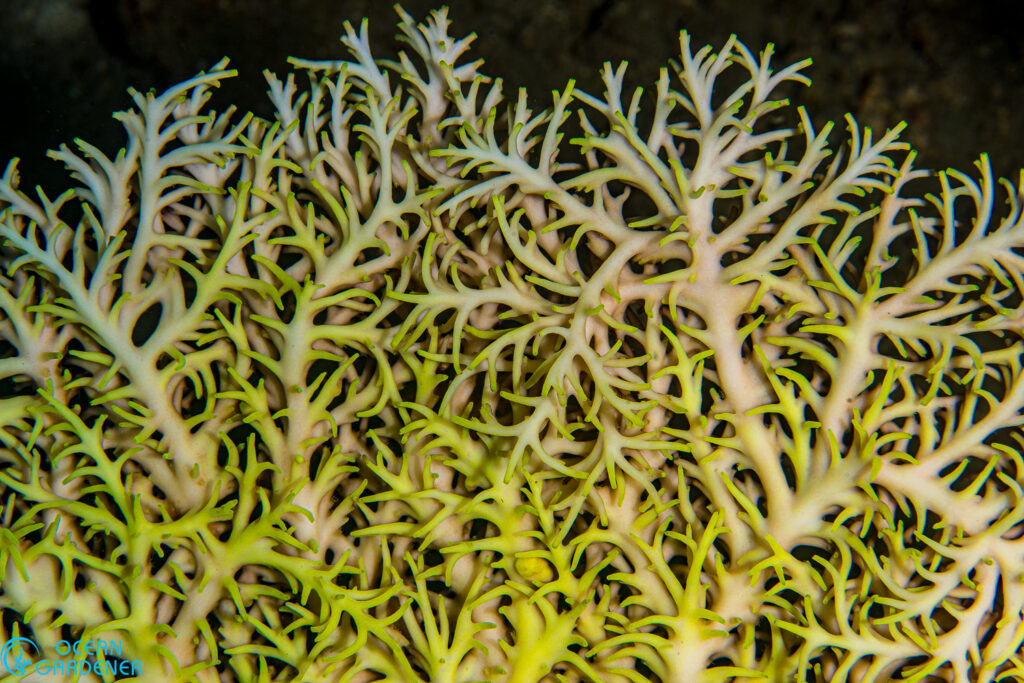
Like Acropora suharsonoi, but in a very different, smaller scale and plan
The Axial corallite-dominated branches are very characteristic of other species, such as Acropora suharsonoi, except in this species, the axial are vertical, not horizontal like in A. jacquelinae. Also, A. suharsonoi has much thicker branches and axials.
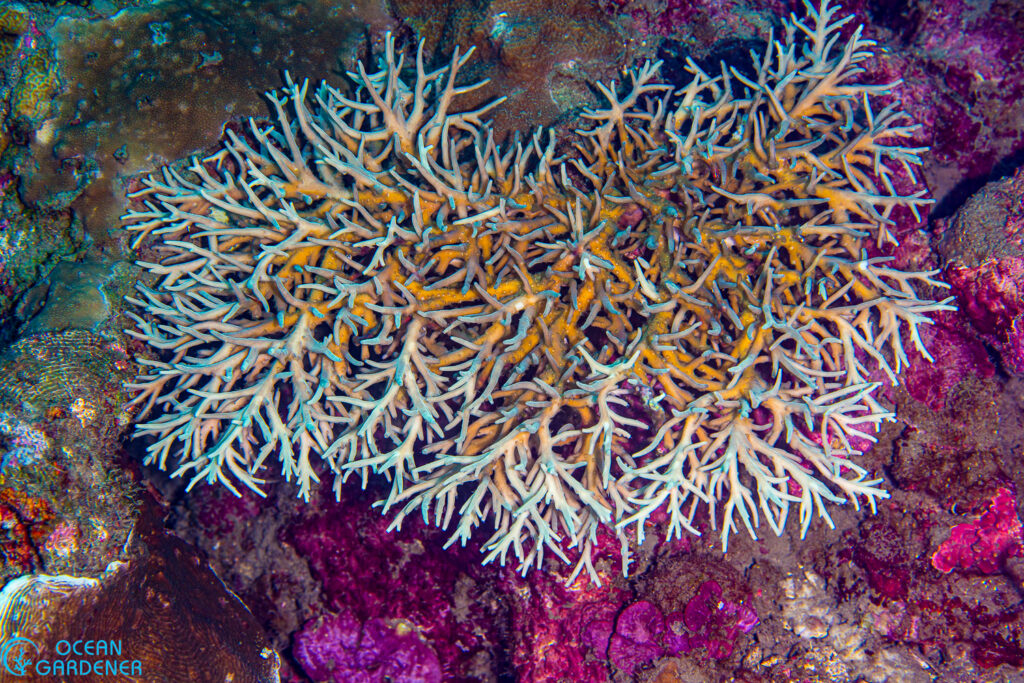
Probably the closest relative is Acropora delsawii. The branch size and corallite are in the same size range. A, jacquelinae is slightly thinner. But again, A. delsawii has many vertical branchlets on top of the colony, but A. jacquelinae has very few.
Some Acropora Jacquelinae Classic Coloration
Most colonies are predominantly brown, with a slight pinkish, blueish hue. Very rarely can we come across a fluorescein green-yellow colony.
Acropora Jacquelinae like Deep, Turbid Habitats
To find this species, you’ll have to go deep, rarely above 25 m. And you’ll have to dive in turbid environments.
They are usually found on steep slopes or walls, tucked in between boulders. So not only does it like a sheltered environment, but it also likes to be protected within that calm environment. It’s probably benefiting from these calm conditions, with a lot of bacterio-plankton dropping on top of it. In that environment, you can only be a slow grower.
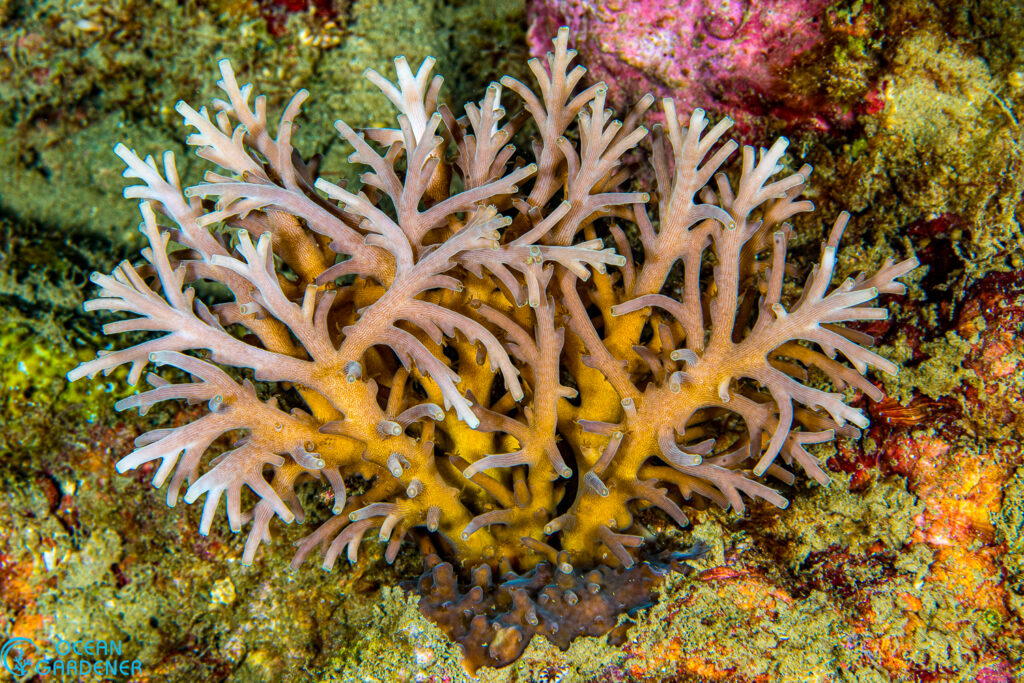
We were happy to find quite a few colonies at this particular spot in North Bali, including a couple of small ones. The large one will be able to fertilize each other, while the small one is a sign of a still healthy population and healthy recruitment. It may be only one small reef, but at least this one shows signs of resilience.
Acropora Jacquelinae is threatened
Unfortunately, this species is highly threatened. It is currently classified as Vulnerable (VU) on IUCN Red List Status. Finding a few colonies on one single small reef doesn’t mean it’s safe.
A single collection run from aquarium collectors, a bleaching event, ghost nets or white plague disease could wipe it out in the blink of an eye. I’m trying to document this species before they go extinct in a few years, as they certainly will. I used to find them everywhere scuba-diving around Bali’s reefs just 10 years ago. I never thought they would disappear. I’m now convinced of it. The worst is that we don’t even know its exact range, ecology, biology yet.
Mastering the Acropora genus
The genus Acropora (staghorn and tabulate corals) is arguably the most ecologically important group of reef-building corals in the world, particularly across the Indo-Pacific. They are considered “foundation species” because their rapid growth rates and diverse, complex branching and plating structures create the bulk of the three-dimensional framework of a coral reef, quickly providing habitat in a coral reef restoration project, bringing back other marine species to the reef.
Acropora Jacquelinae is one of the many unique species that have a specific niche on the Indo-Pacific reef. If you are interesting in getting a good overview of the fundamental genus in any coral restoration project and see this species in its natural habitat, come join our Acropora ID course. Maximize your success rates for your coral restoration projects and help contribute to our coral reef restoration efforts here in Bali, Indonesia.