
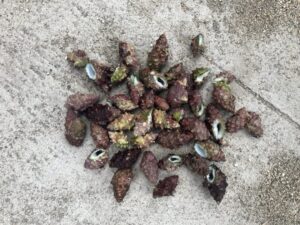
Drupella: The Silent Coral Killers You Need to Know
Maintaining healthy coral nurseries and reef restoration sites involves regular monitoring, cleaning, and addressing pests like Drupella snails. These snails can cause significant damage to shallow reefs across Indonesia, and we consistently find them at our project sites. In our experience, Drupella snail outbreaks are a major cause of long-term restoration project failures in Indonesia, making consistent monitoring essential. To help protect the coral, we often need to manually remove these snails, sometimes collecting several hundred during a single dive. Spotting the noctornal Drupella snails Drupella snails are often difficult to spot during the day, as they conceal themselves at coral bases among algae and other sessile organisms. However, they emerge at night to feed on coral tissue. As colonial mollusks, they congregate in groups, allowing for efficient collection when an aggregation is located. Drupella snail feeding patterns, while distinctive, can be confused with white band disease. Unlike the rapid devastation caused by Crown-of-Thorns starfish, Drupella snails feed slowly, leaving
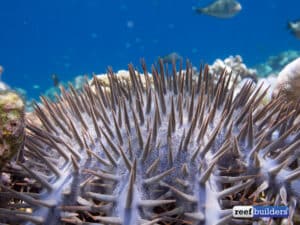
What you should know about the Crown-of-Thorns starfish
Acanthaster planci, more commonly known as the Crown-of-Thorn starfish, is a voracious predator which feeds on stony coral polyps. The starfish gets its name from the toxic thorn-like spines covering its body, which resemble a biblical “crown of thorns”. The Crown-of-Thorns starfish is wide spread and found mainly in Australia and the Indo-Pacific. Unfortunately, the Crown-of-Thorns is becoming more common outside the Indo-Pacific and is known to occur in the tropical and subtropical regions of East Africa, the Red Sea, and have been documented as far away as South America, where you find coral reefs. Crown-of-Thorns prefer to feed on branching or table corals like Acorpora sp. but will also feed on Porites or Motipora corals, and have been documented feeding on sponges, soft corals, and encrusting organisms like algae. If you happen to come across one of these starfish DO NOT touch the body or long spines as this can cause a severe sting, pain, and swelling that can last
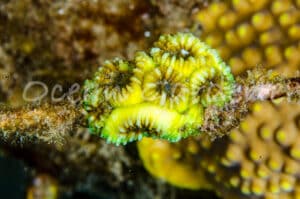
Micro-Fragmentation in-situ, a first by Ocean Gardener
With over 20 years of coral planting experience and a background in marine aquaculture, we’ve consistently sought efficient solutions for large-scale coral production for coral reef restoration. Here is one of trials that have yielded good results. What is micro-fragmentation? Micro-fragmentation involves sectioning corals into small fragments of 1 to 5 polyps using a specialized band saw. This technique stimulates rapid tissue growth, resulting in clonal expansion at 25 to 50 times the normal rate. Micro-fragmentation accelerates coral growth by triggering a robust healing response. When corals are sectioned into small fragments, they prioritize tissue repair, leading to rapid cell division and regeneration. This process also increases the surface area to edge ratio, enhancing nutrient uptake and gas exchange, which further fuels tissue growth. In essence, this technique manipulates the coral’s natural healing mechanisms, effectively stimulating rapid tissue growth and resulting in growth rates far exceeding those observed in natural conditions. While the term gained popularity on social media due
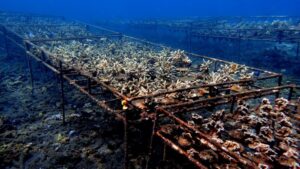
Update: Our progress with the Amed, north Bali coral nursery
An update on our coral nursery located in Lipah Bay, Amed in the North-east part of Bali. The project has shown consistent success in recent months. The coral nursery, first established in June 2019, is already supplying coral fragments for reef transplantation for the past five months. Our nursery currently houses nine racks, with four actively producing fragments from six distinct coral species. These are coral species we have selected that are adapted to the conditions here in Amed. Similar to our Sanur nursery, we utilize good and sound ecological principles to ensure maximum survival amongst the coral frags, based on our 25 years of coral growing experience for the marine aquarium trade. In our nursery, we have: The number of species and the quantity of frags will quickly ramp up. We already planted over 100 frags on the reef, using different techniques. We also planted 5 spiders on the slope, and seeded with frags. Addition of new racks To
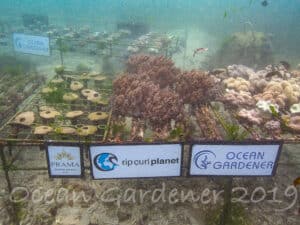
Rip Curl School of Surf partners with Ocean Gardener in Sanur, Bali
With our vision to expand coral nurseries across Indonesia through partnerships with resorts and dive shops, Ocean Gardener is proud to announce our collaborative partnership with Rip Curl, the Rip Curl School of Surf and the Prama Sanur Beach Hotel. This initiative marks the establishment of an Ocean Gardener coral nursery in Sanur, located in front of the Rip Curl School of Surf and the Prama Sanur Beach Hotel. This project will be a key initiative for Prama Sanur Beach Hotel and Rip Curl’s social and environmental responsibility efforts in Indonesia. In a collaborative effort, the Prama Sanur Beach Hotel, Rip Curl, and the Rip Curl School of Surf are joining forces with local hotels, resorts, dive centers, and schools in Bali. Their mission is to educate both the community and tourists on the vital role of coral reefs and the necessity of restoration projects in Sanur. These initiatives will not only help rebuild reef fish populations but also provide
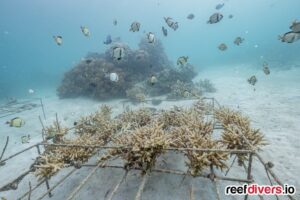
Update: Coral Restoration, Bangka Island Sulawesi Indonesia
Coral Restoration Bangka Island It’s been nearly six months since we started collaborating with Ocean Gardener and Murex Dive Resorts on a coral identification and restoration project in Bangka Island Sulawesi. And we’re happy to report that coral fragments are growing nicely, and we’ve started transplanting corals to their final restoration site. If you’re interested to learn how to identify corals you can now take a full three day, five dive course with trained instructors and become a certified coral diver! Check it out, it’s called the Ocean Gardener Coral Diver Course. As part of this course, you are able to visit the Murex Bangka Island coral nursery and help with the ongoing coral restoration work. https://www.facebook.com/OceanGardener/videos/296300224641064 The coral reefs in North Sulawesi are already quite healthy and, have been identified as one of the 50 reefs around the world which are least vulnerable to climate change and have the highest potential for regenerating in the future. In a Seaview
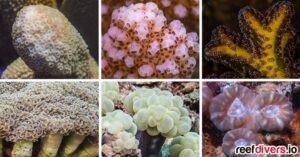
Learn to Spot Six Types of Branching Coral
Coral reefs are more than just stunning underwater landscapes; they are the bustling metropolises of the ocean, serving as essential shelter, breeding grounds, and food sources for a vast array of marine life. Their intricate, three-dimensional structures provide refuge from predators and harsh currents, creating nurseries for countless juvenile fish and invertebrates. From the vibrant clownfish nestled within anemones to the large, predatory sharks hunting along the reef’s edge, coral ecosystems support an astonishing biodiversity. Understanding the crucial role these reefs play in housing marine life is fundamental, whether you’re a curious novice or a dedicated coral restoration enthusiast. Learning to positively identify coral species and understanding their preferred niches is crucial. By recognizing the specific conditions each species thrives in – water clarity, depth, current strength, and substrate – you’ll be able to locate them more effectively during dives or surveys. This knowledge becomes particularly powerful in coral restoration efforts, where selecting and propagating the proper, locally adapted species
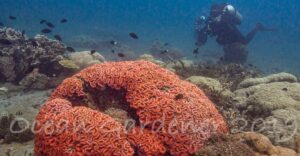
North Sulawesi Is Home To Some Of The Biggest Coral Colonies Alive in Indonesia
Our ongoing partnership with Murex Resorts in North Sulawesi (Manado, Bunaken, and Bangka) allows us to explore their sites’ remarkable coral species and marine biodiversity. Each visit increases our knowledge and strengthens our fascination, leading to us being “hooked” and needing to return to see more! Oversized Coral Colony Heaven On our most recent trip, we went to train local communities about coral reef preservation and restoration. One thing really struck us at this time: the large quantity of huge, oversized coral colonies present at the 3 dives sites. Some of the coral colonies are as large as houses, with a lot of colonies the size of trucks. It’s amazing. When recalling the largest colonies of various marine species, North Sulawesi dominates our memories about 95% of the time. Notably, Batas Kota in Manado Bay boasts a massive hammer coral, Euphyllia (Fimbriaphyllia) ancora, extending to the horizon. Fukui point in Bunaken, North Sulawesi is another site where you can find