
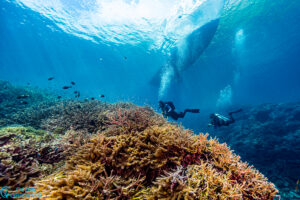
Banda Neira: Discovering a hidden paradise
Our team goes to Ambon to do a reconnaissance dive, check out the corals and ecosystem in this part of Indonesia. We share our experience in this latest blog post.
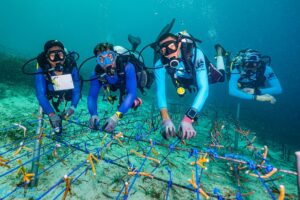
Ocean Gardener’s 4 Weeks Coral Restoration Certificate in Raja Ampat, West Papua
Jonathan takes us through our recent course done for the first time in Raja Ampat in collaboration with our partner NGOs. We live aboard Galaxea with seven scholarship recipients and learned about corals and the different methods of restoring. Follow our journey and learn about the participants in this course.
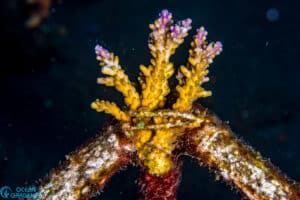
Impressive results after 2 weeks of running our Mineral Accretion Technology pilot
We revisited our first Mineral Accretion Technology (MAT) after 2 weeks to monitor its progress. You can read our previous blog post about the MAT system installation. It goes through the installation process and technical details of our pilot site in front of our partners, the MERO Foundation, in Tulamben, East Bali. It took many years to convince us to try Mineral Accretion Technology (MAT). Like many, we had been disappointed with the published results achieved by various organizations using this technique in their own projects. Nevertheless, being stubborn, we preferred to see for ourselves what this technique offered and if it could be a viable tool for coral restoration. Ring Layout Of Coral Tables and Reef stars The idea was to have a homogeneous inner ring of tables and an outer ring of Reef Stars around the Anode. Every structure of the same size is placed at the same distance from the Anode as the others, thereby receiving exactly
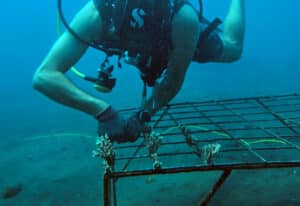
Our Mineral Accretion Technology Pilot Test
Last month, Ocean Gardener started a pilot trial for Mineral Accretion Technology (MAT) in Tulamben, East Bali, to assess its effectiveness in promoting faster and healthier coral growth compared to existing methods. We go behind the scenes for a look at how we did it and the materials we chose.
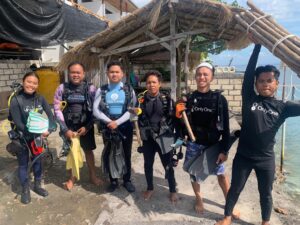
Sustaining What We’ve Planted: The Importance of Coral Reef Maintenance with Local Communities in Bali and Nusa Penida.
We know successful coral reef restoration is more than just planting fragments; it requires long-term maintenance and community involvement. In this article, we explore what that means and how we collaborate with the local community.
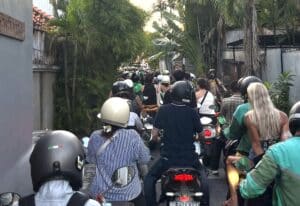
Will Nusa Penida Succumb to Over Tourism Like Bali?
Our new blog post examines the threat of unsustainable tourism development in Nusa Penida to the coral reefs. While the Marine Protected Area (MPA) has been established since 2010, land-based pollution from unchecked development is starting to degrade these vital ecosystems.
Our coral restoration efforts in Ped show promising progress, but the long-term health of Nusa Penida’s marine life depends on sustainable management, including clear guidelines for visitors and developers, robust waste management, and comprehensive environmental protection. Let’s protect this paradise!
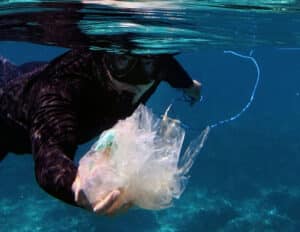
Bali’s Plastic Problem: A 2026 Update on the Fight for a Cleaner Paradise
Our latest blog post looks at the recent plastic ban in Bali. With all the plastic pollution we saw during our dives, we were curious about the recent plastic ban. Bali generates 3,436 tons of waste daily, with landfills overflowing into illegal disposal. The ban is set for full enforcement by January 2026 will span all sectors including government, businesses, and schools, is a key step towards Bali’s ambitious goal of becoming waste-free by 2027.
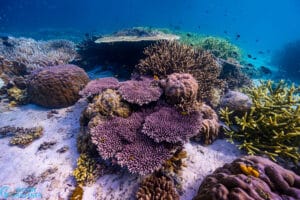
Common Coral Outplanting Methods Used In Coral Restoration
One of our founders, Vincent Chalias, shares the 7 most common outplanting methods used in coral restoration and their pros and cons.
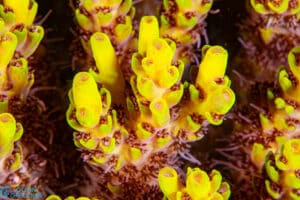
Why Acropora are important?
Acropora is the largest genus of hard corals Boasting an impressive diversity of 140 to 400 species, Acropora stands as the world’s most expansive genus of hard corals. While often characterized by their striking tabular or branching structures, their true uniqueness lies in the presence of specialized polyps: a leading axial polyp positioned at the very tip of each branch, guiding its outward growth, and numerous smaller radial polyps that populate the branch’s lateral surfaces. They dominate the shallow reefs but can also be found in the depths of 120m in the mesophotic zone. Acropora play a very important ecological role Acropora colonies are the bustling metropolises of the reef, providing indispensable habitat for an astonishing array of fish. Their complex, branching forms interlock to create thick, protective canopies and intricate labyrinths, serving as vital refuges and nurseries. From the tiny damselfish darting among their intricate branches to the imposing reef shark finding shelter beneath vast tabular formations, marine life
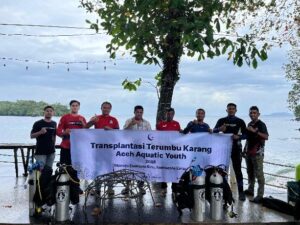
An insight into Aceh’s coral reef restoration efforts
Ibnu, one of our scholarship recipients, gives us an insight into his organization and their methods and his learning after 4 weeks with us.
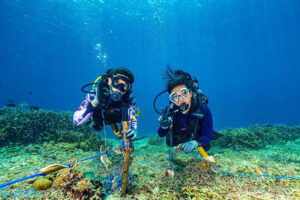
Citra’s lifechanging experience with coral restoration
Citra was one of the 4 Indonesians selected by Ocean Gardener to receive our scholarship to take part in our Full Coral Restoration Certification course. She shares her experience spending the 4 weeks with other students learning more about corals, their restoration and applying these lessons practically during their dives in various locations around Bali, Indonesia. I never imagined that a single email could change the course of my journey in marine conservation. When I received the news that I had been awarded a scholarship to join Ocean Gardener’s coral reef restoration course, I was beyond excited. Opportunities don’t always knock twice, and when the chance to take part in a coral reef restoration course through a scholarship came my way, I knew I had to take it. This experience not only expanded my knowledge, but also deepened my commitment to protecting our oceans. So last month, I started the 4 week coral reef restoration course through the scholarship. The
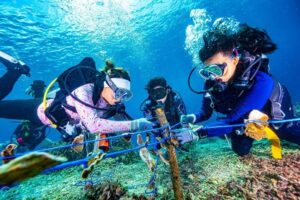
Ivon’s inspiring 4 week journey in coral restoration
Ivon was one of the 4 Indonesians selected by the Mero Foundation to receive a scholarship to take part in Ocean Gardener’s Full Coral Restoration Certification course. She shares her experience spending the 4 weeks with other students learning more about corals, their restoration and applying these lessons practically during their dives in various locations around Bali, Indonesia.